What "Non-Toxic" Really Means: The Certifications Worth Trusting
Published May 26, 2026 · Last updated May 26, 2026 · By Gabriela Fiorentino, LEED AP
"Non-toxic" isn't a regulated term, but six specific certifications are. This guide compares GOTS, OEKO-TEX, MADE SAFE, GREENGUARD Gold, GOLS, and CertiPUR-US by what they actually exclude — and links the five public verification databases that let you check any product on a shelf in thirty seconds. I've worked with material certifications as a LEED-accredited sustainability professional, and the same logic that applies to buildings applies to what you buy for your kids.
- "Non-toxic," "natural," and "clean" are unregulated marketing terms. Six specific certifications have published criteria and third-party verification.
- GOTS bans PFAS by default. OEKO-TEX Standard 100 limits PFAS to ≤10 ppm. GREENGUARD Gold and CertiPUR-US do not currently address PFAS.
- MADE SAFE's Red List screens against more than 6,500 substances — the largest consumer-facing chemical exclusion screen.
- The Strictness Ranking: MADE SAFE > GOTS + OEKO-TEX combined > GOTS alone > OEKO-TEX alone > GREENGUARD Gold > CertiPUR-US.
- Every legitimate certification maintains a public verification database. Search a product in 30 seconds; if it doesn't appear, the seal isn't real.
The Six Non-Toxic Certifications Worth Knowing
Hundreds of seals appear on baby products. Six of them have real published criteria, real third-party verification, and real public databases. The rest are marketing.
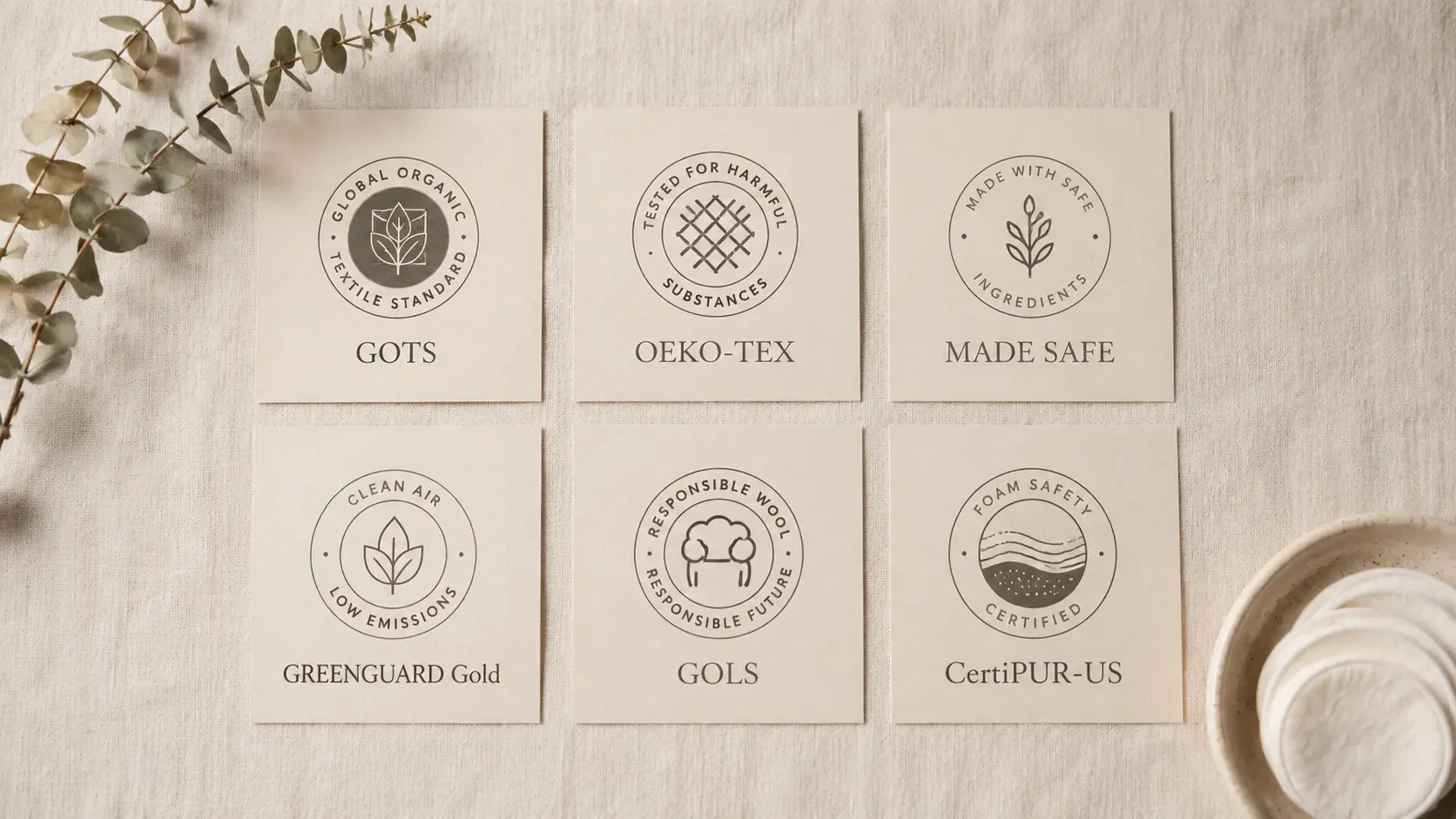
GOTS — Global Organic Textile Standard
For fabrics. Requires at least 70% certified organic fibers and covers the full chain from fiber to finished product, including processing, manufacturing, packaging, labeling, trading, and distribution[4]. Bans PFAS by default. Strongest signal for organic-fiber sleep, swaddle, and clothing items.
OEKO-TEX Standard 100
For finished textile products. Tests the actual final product (not just the inputs) for harmful substances at every production stage. PFAS limit ≤10 ppm as of 2023 standard update[2]. The strongest signal for chemical-residue safety on conventional or blended fabrics.
MADE SAFE
For consumer products across categories: skincare, baby care, household goods, mattresses. Screens against the MADE SAFE Red List of more than 6,500 banned or restricted substances — significantly larger than the EU's restricted list and hundreds of times larger than US-restricted lists[3]. The most comprehensive consumer-facing chemical screen.
GREENGUARD Gold
For low-VOC indoor-air-quality products: mattresses, furniture, flooring, electronics. Tests emissions levels at or below 1/100th of the safe levels established by the US Consumer Products Safety Commission[3]. Critical for the nursery's biggest off-gassing pieces. Does not currently address PFAS in textiles.
GOLS — Global Organic Latex Standard
For natural latex products, primarily mattresses and toppers. Requires at least 95% certified organic raw material content. The textile equivalent of GOTS for the latex category specifically.
CertiPUR-US
For polyurethane foam products. The weakest of the six — verifies the absence of certain restricted substances (PBDEs, mercury, lead, ozone-depleters) but is industry-funded and does not address PFAS or many other compounds. Useful as a minimum bar for polyurethane foam, not a strong signal of safety.
GOTS vs OEKO-TEX: When Each One Wins
This is the question I get most often, and the honest answer is that they are not competitors — they cover different things.
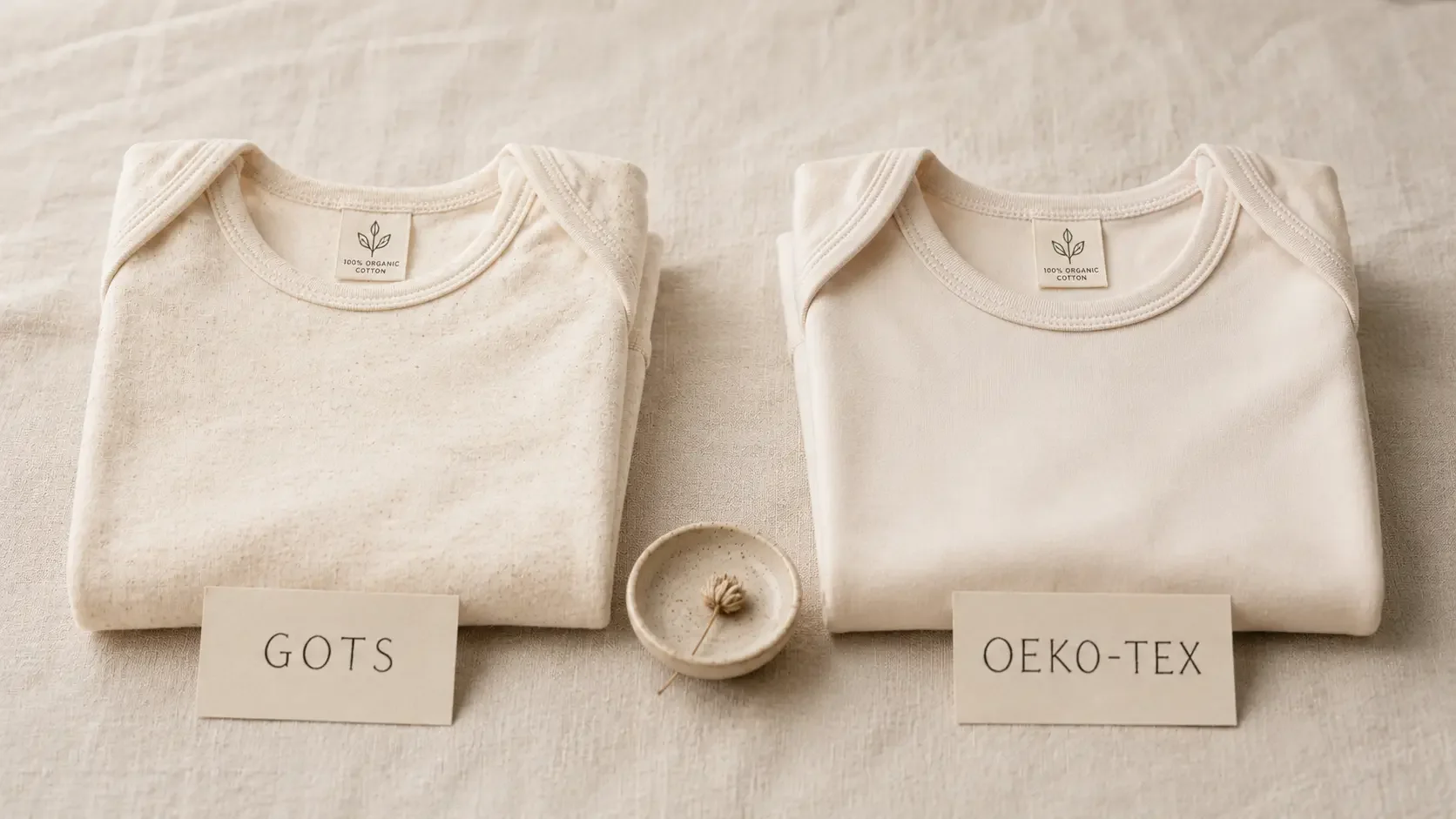
GOTS goes deeper on origin. The fiber must be certified organic. The farming practices, the processing chemicals, the wastewater handling, the labor conditions, the packaging — all certified. PFAS banned by default at the input level. If the question you care about is "how was this made, from seed to finished garment," GOTS is the answer.
OEKO-TEX goes deeper on the finished product. It doesn't certify how the fiber was grown. It tests the final product's chemical residues against a published limit list, including dyes, formaldehyde, heavy metals, pesticides, and PFAS (≤10 ppm)[2]. If the question you care about is "what chemicals are actually in this garment as I'm holding it," OEKO-TEX is the answer.
The strongest signal is when a product carries both. GOTS-certified organic fiber that also passes OEKO-TEX final-product residue testing covers both ends of the chain.
Want the printable certification-by-product-category cheat sheet our community uses? It's in our community library.
Join the Community →MADE SAFE, GREENGUARD Gold, and Beyond Textiles
The other four certifications cover the categories that aren't fabric — and these are the categories most parents underestimate. As a LEED AP, I worked with material certifications for buildings before having kids, and the same logic applies here: the items that touch your baby's skin for the longest, that off-gas into the air your baby breathes, that contain the most polymer mass — these are the categories where certifications matter most.
For mattresses, sleep surfaces, and major furniture: GREENGUARD Gold is the indoor air quality benchmark. The crib mattress your baby will sleep on for 14 to 17 hours a day in the first months. The dresser, the glider, the rug. These are the slow-burn off-gassing sources that affect the nursery's air for years.
For skincare, baby wash, and personal care: MADE SAFE or EWG VERIFIED. Skincare is absorbed transdermally, so the ingredient list matters more here than almost anywhere else. MADE SAFE's 6,500-substance Red List is broader than what I used to look at on LEED projects.
For natural latex mattresses and pillows: GOLS. The latex equivalent of GOTS.
The Strictness Ranking — Which Excludes the Most Substances
By number of restricted substances and depth of supply-chain coverage, the six certifications rank like this from strictest to loosest:
1. MADE SAFE — Red List of 6,500+ substances.
2. GOTS + OEKO-TEX combined — origin + finished-product residue.
3. GOTS alone — strongest single-certification organic-chain signal.
4. OEKO-TEX Standard 100 alone — strongest single-certification finished-product test.
5. GREENGUARD Gold — strong on air emissions, weak on PFAS and supply chain.
6. CertiPUR-US — minimum bar for polyurethane foam; weakest of the six.
This is a relative ranking, not an absolute one. Each certification excels at a different thing. The right question is "which certification matches what I'm buying?" — answered in the decision tree below.
Start with what you are buying. The decision tree matches the right certification to the right category — and the universal verification step always applies.
Licensed under CC BY 4.0. Free to use with attribution and a link back to this post.
The Five Verification Databases You Can Search in 30 Seconds
Every legitimate certification on this list maintains a public, searchable database of certified products and certified brands. This is the single fastest way to detect fake or expired seals.
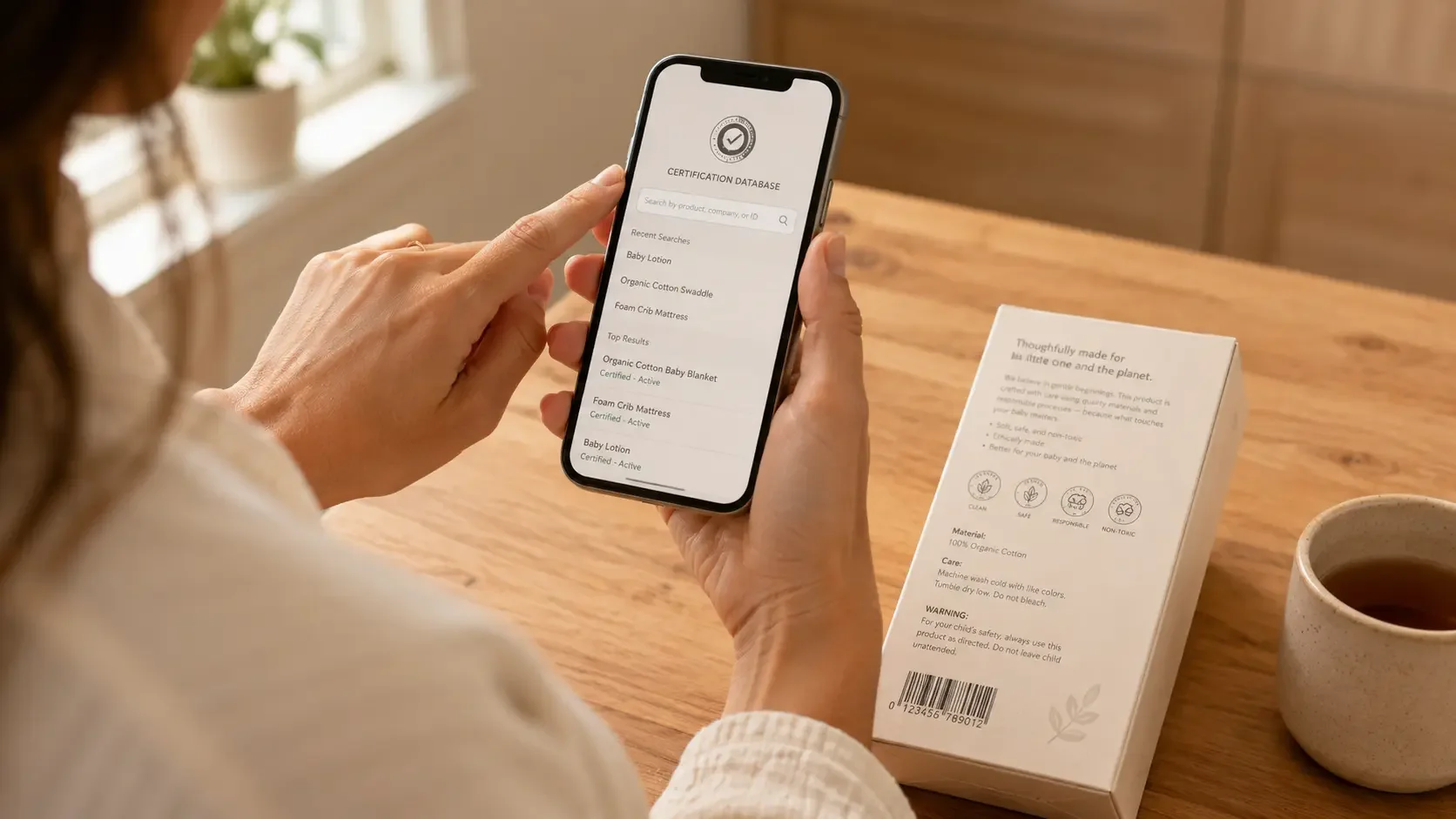
Step 1: Identify which certification is claimed on the package.
Step 2: Visit that certification's public database (links below).
Step 3: Search for the brand name or specific product name.
Step 4: If it doesn't appear, the seal is either fake, expired, or unaffiliated with the actual certifier.
The whole process takes 30 seconds from a phone in a store aisle. It catches the majority of self-designed and lapsed certifications.
| Certification | Public Verification Database |
|---|---|
| GOTS | global-standard.org/find-certified-products |
| OEKO-TEX | oeko-tex.com/en/our-standards/label-check |
| MADE SAFE | madesafe.org/products |
| GREENGUARD Gold | spot.ul.com/main-app/products/catalog |
| EWG VERIFIED | ewg.org/ewgverified |
For natural latex (GOLS), verification routes through individual certifier websites; for polyurethane foam (CertiPUR-US), use certipur.us/find-products. The five above are the highest-volume daily-use databases for parents.
"Non-toxic" is not a regulation. It is a marketing claim. The work is to identify which claims have something real behind them — and to verify, once, in 30 seconds, before the wallet leaves the pocket.
For the upstream label-reading skill, see how to spot greenwashing in baby products. For applying these certifications across an entire registry, see our non-toxic baby registry framework. For PFAS-specific certification interpretation, see PFAS in kids' clothes.
Frequently Asked Questions
What does GOTS certified mean?
GOTS (Global Organic Textile Standard) certifies textiles containing at least 70% certified organic fibers, covering the full chain from fiber to finished product including processing, manufacturing, packaging, labeling, trading, and distribution. GOTS bans PFAS by default and prohibits many other substances at the input level.
Is OEKO-TEX or GOTS better?
Neither is universally better; they cover different things. GOTS goes deeper on origin (organic farming, processing, labor). OEKO-TEX goes deeper on finished-product chemical residue testing — it tests the actual final product for harmful substances. For organic content and farming standards, GOTS wins. For chemical-residue safety on the finished product, OEKO-TEX wins. The strongest signal is when a product carries both.
What's the strictest non-toxic certification?
By number of restricted substances, MADE SAFE is the strictest — its Red List screens against more than 6,500 substances. By scope, GOTS is broader (covering origin, labor, and chemistry). The strictness ranking depends on what you're measuring: chemical exclusion list, organic content, or production-chain transparency.
Which certifications actually exclude PFAS?
GOTS bans PFAS by default. MADE SAFE excludes PFAS via its Red List. OEKO-TEX Standard 100 limits PFAS to ≤10 ppm as of 2023 — significantly restricted but not zero. GREENGUARD Gold does not currently address PFAS in textiles. CertiPUR-US does not address PFAS.
How do I check if a product's certification is real?
Every legitimate certification maintains a public verification database. Visit the certifier's website, find the certified-product or certified-brand database, and search by brand name or product name. If the product or brand doesn't appear, the seal on the package is either fake or expired. This 30-second check catches the majority of self-designed seals.
References
- Sierra Club. (2023). Safer, Greener Textiles and How to Vet Ecolabel Certifications (citing Renée Sharp, SaferStates strategic adviser). sierraclub.org/sierra/ask-ms-green
- OEKO-TEX. (2023). Standard 100 by OEKO-TEX: Test Criteria and Limit Values 2023. oeko-tex.com/our-standards/oeko-tex-standard-100
- LeafScore. (2024). The Most Important Green Mattress Certifications (citing MADE SAFE published criteria and UL GREENGUARD published criteria). leafscore.com/mattress-guide
- Global Organic Textile Standard. (2023). GOTS Version 7.0 General Description. global-standard.org/the-standard
- UL Environment. (2024). GREENGUARD Certification Program Methodology. ul.com/services/greenguard-certification
Want the certification-by-category cheat sheet?
Join the free Nest Earth community for the printable certification-by-product-category reference, updates when standards change, and parents working through the same calculus you are.
Join the Community →