Microplastics and Your Baby: What the Latest Research Actually Says
Published May 18, 2026 · Last updated May 18, 2026 · By Gabriela Fiorentino, LEED AP
If you've seen the microplastics headlines and felt that particular brand of new-parent dread, this guide is built for you. The research is real, the numbers are large, and the response can still be calm. Here's what the peer-reviewed evidence says as of 2026, what it doesn't yet say, and the four changes parents can make today that genuinely move the dial.
A note on this guide: Microplastics research is moving fast. This article reflects peer-reviewed findings published through May 2026. If a major new study has come out since you're reading this, check back — we update as the science evolves.
- The single largest source of infant microplastic exposure isn't formula or breast milk — it's the bottle prep step.
- Polypropylene baby bottles can release up to 16.2 million microplastic particles per litre during hot-water formula prep (Nature Food, 2020).
- Microwaving food in plastic containers releases millions of particles into the food in three minutes (Environ. Sci. Technol., 2023).
- Four parent-controllable changes — cold-water rinse before sterilization, room-temperature prep when safe, glass for hot/oily contact, no microwaving plastic — cut most of the exposure.
- Long-term health effects of infant microplastic exposure are not yet established; the precautionary case for reducing exposure is reasonable but not proven.
The Two Big Findings From 2020–2024 Research
If you read only two findings from the peer-reviewed microplastics literature on infant feeding, read these. They are the studies that change the math on what parents should focus on.
Finding 1: Bottles Shed More Than Anyone Expected
In October 2020, researchers Li, Shi, Wang, and colleagues published a study in Nature Food titled Microplastic release from the degradation of polypropylene feeding bottles during infant formula preparation[1]. Their measured release rate, under standard formula preparation conditions: up to 16.2 million microplastic particles per litre. Per litre. Of formula. Prepared the way most parents are explicitly instructed to prepare it by manufacturers and pediatricians.
Finding 2: Microwaving Plastic Containers Is Worse
A 2023 University of Nebraska-Lincoln study published in Environmental Science & Technology found that microwaving plastic baby food containers for three minutes released over four million microplastic particles and over two billion nanoplastic particles per square centimeter of container surface area[2]. These particles ended up in the food, then in the baby.
Where the Particles Actually Come From: Breast Milk vs. Formula vs. Bottles
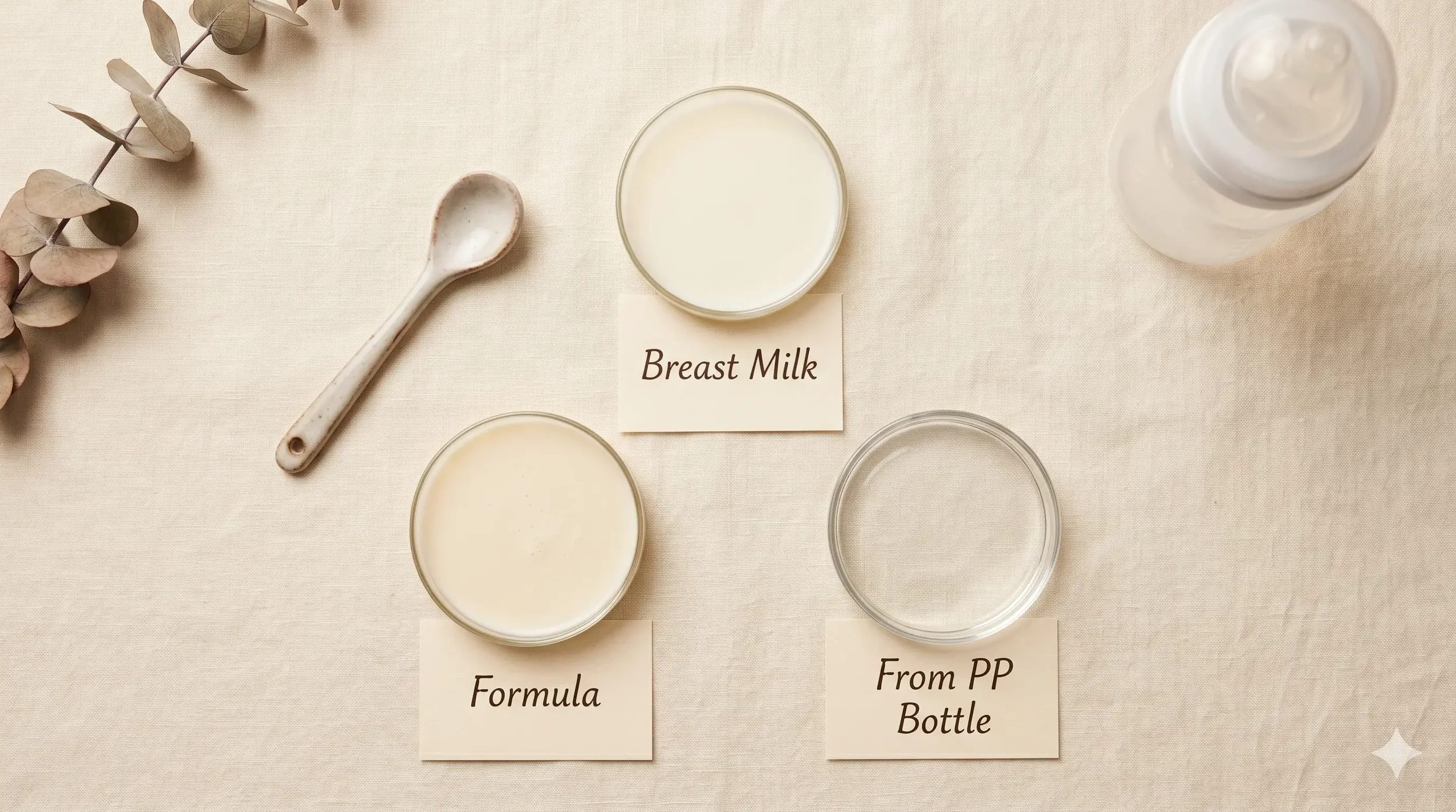
There's a question I get often: doesn't breastfeeding solve this? The honest answer is that breastfeeding helps but doesn't eliminate exposure. Multiple studies have detected microplastics in breast milk samples[4]. The bigger story is that for formula-fed babies, the bottle is a much larger contributor than the formula itself.
Formula Itself: Modest Contribution
A 2024 study by Liber and colleagues isolated microplastics in infant formula powder at an average of 42 ± 27 particles per 100g[3]. Real, measurable — but a small fraction of what subsequent bottle preparation adds.
The Bottle Prep Step: The Dominant Source
A 2023 peer-reviewed analysis published via PubMed quantified the relative contributions and found that microplastic exposure from polypropylene feeding bottles was approximately 6.8 times higher than from the formula powder itself[4]. The process is releasing more particles than the ingredient.
Breast Milk: Smaller, but Present
Breast milk has been found to contain microplastics in multiple sampling studies, likely reflecting environmental microplastic intake by the mother. The exposure is meaningful in absolute terms but is generally far smaller than the bottle-preparation contribution for formula-fed babies. Breastfeeding remains the AAP-recommended choice where possible; the microplastics question doesn't change that conclusion.
Four peer-reviewed findings on infant microplastic exposure. The bottle-preparation step contributes more than any other single source.
Licensed under CC BY 4.0. Free to use with attribution and a link back to this post.
Bottle Material Comparison: Polypropylene, Glass, Stainless Steel, Silicone
The four common bottle materials sit on a spectrum from highest to lowest shedding under heat contact. The honest version:
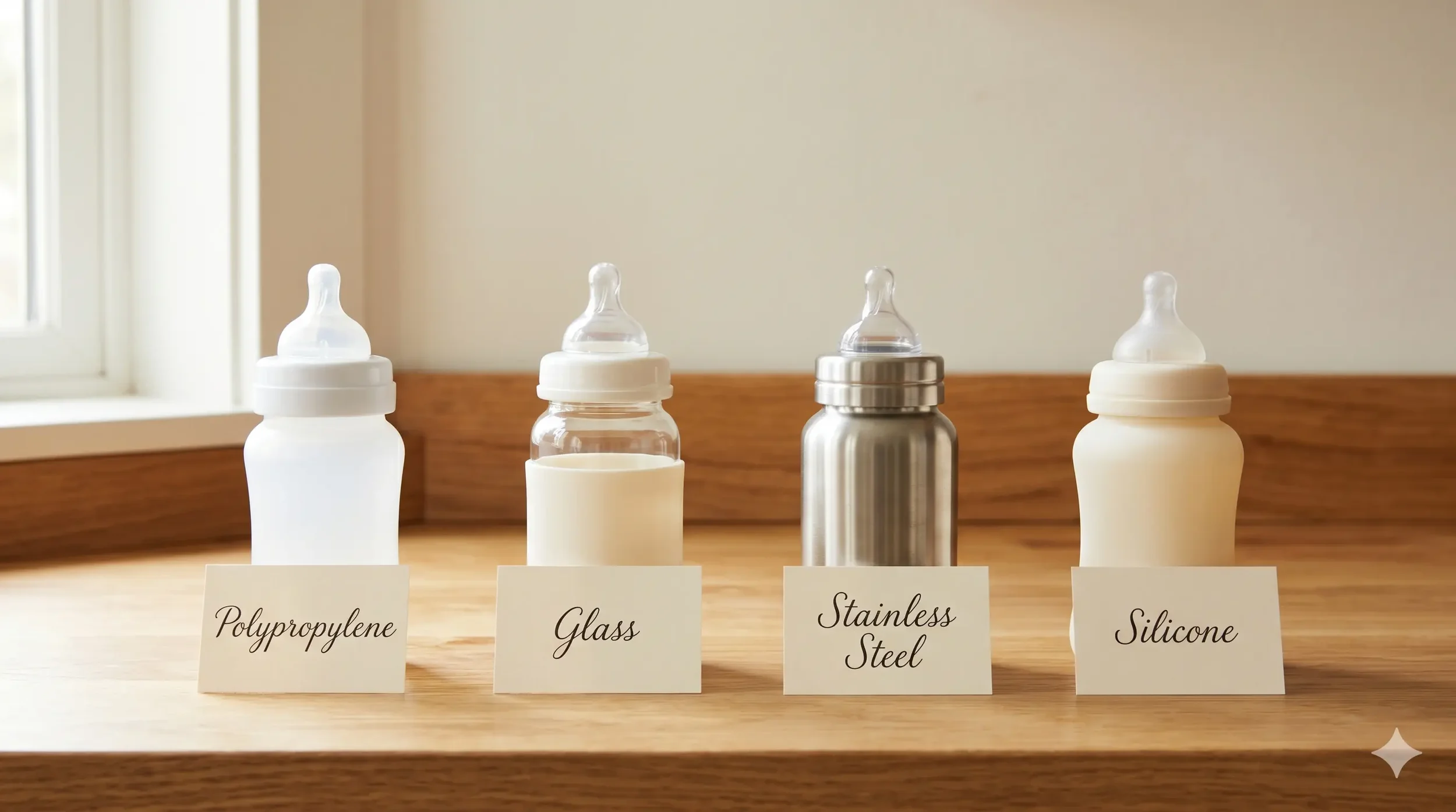
- Polypropylene (PP, recycling #5): The most common baby bottle material. Sheds the most under heat. The 16.2 million particles per litre figure is specifically from PP. Safer when used only with cold or room-temperature contents.
- Glass: Sheds no microplastics. Heavier, breakable. The clear winner for any hot-water or oily-food contact. Most-cited alternative for the bottle-prep step specifically.
- Stainless steel: Sheds no microplastics. Insulated, durable, doesn't break. Heavier and more expensive upfront. Often the best practical choice for parents prioritizing durability alongside material safety.
- Silicone (food-grade): Stable across a wide temperature range. Some studies have detected silicone migration under extreme conditions, but it is generally considered safer than PP for the bottle-prep step. A reasonable middle ground for parts that need to be flexible.
Want the full non-toxic bottle and feeding gear breakdown? It's part of our complete registry framework.
Read the Registry Guide →The Four Parent-Controllable Changes That Cut Most Exposure
These are the operational changes that follow from the research. None of them require buying everything new. Three of the four are free.
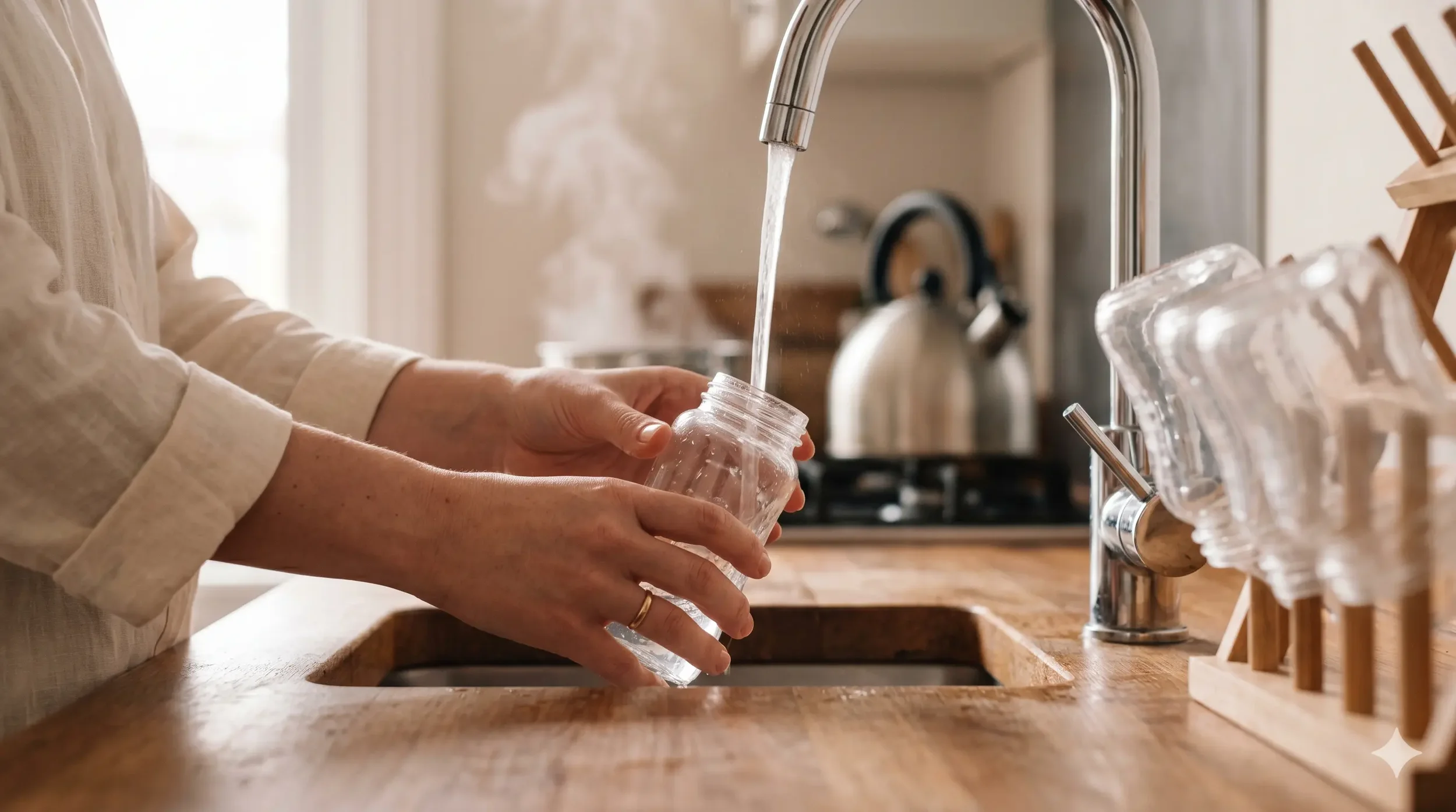
- Cold-water rinse before sterilization. The Nature Food study found that pre-rinsing bottles with cool water before high-temperature sterilization reduced subsequent microplastic release by a substantial margin. The same applies after sterilization — rinse with cool water before adding hot formula water.
- Prepare formula at room temperature when safe. AAP guidance accepts room-temperature formula prep for healthy term babies when the water is from a verified safe source. Hot water creates the particles; cold water doesn't. For preterm babies and high-risk situations, follow your pediatrician's heating guidance.
- Use glass or stainless steel for any hot-water or oily-food contact. If your morning routine involves boiling water poured directly into a plastic bottle, switching that one bottle to glass is the single highest-impact change in the entire framework. Other bottles can remain whatever they are.
- Never microwave food or milk in plastic. Transfer to glass or ceramic, then microwave. The 2023 study makes this one non-negotiable: three minutes of microwaving plastic releases millions of particles into the food.
What We Don't Yet Know — and What That Means
Honesty about uncertainty matters here. We do not yet have settled answers on what infant-scale microplastic exposure does to long-term health outcomes. The studies that have established that exposure occurs at the volumes reported above are robust. The studies establishing what those exposures cause are early and ongoing.
So what does the precautionary case look like? It looks like reasonable, low-cost behavior changes that reduce a known exposure without requiring extreme lifestyle disruption. Switching a hot-water bottle to glass costs $15 to $25. Stopping plastic-microwave practice costs nothing. These changes are defensible under any future research scenario.
What the precautionary case does not justify is panic. The state of the evidence does not support the framing of "every plastic bottle is poisoning your baby," and it does not justify throwing out a working feeding setup overnight. The data justifies a calm, informed switch to lower-shed alternatives where it makes sense for your family.
The honest answer to most "is X harming my baby?" questions in 2026 is: probably less than the headlines suggest, more than nothing, and yes, you can reduce it without panic.
For the broader context on what "non-toxic" actually means and which certifications cover infant feeding equipment, see our certifications guide. For how this fits into the larger registry decision, see our non-toxic registry framework.
Frequently Asked Questions
How much microplastic does my baby actually consume from their bottle?
A 2020 Nature Food study found that polypropylene infant feeding bottles can release up to 16.2 million microplastic particles per litre during formula preparation when heated water is added to the bottle. The exact exposure depends on the bottle material, water temperature, and how often the bottle is reused.
Does breastfeeding avoid microplastic exposure entirely?
Breast milk has been found to contain microplastics in multiple studies, so it does not eliminate exposure entirely. The primary source for formula-fed babies is the bottle preparation process itself, not the formula or the breast milk.
Is glass really safer, or just different?
Glass does not shed microplastics, so for any contact with hot water or oily foods, glass is meaningfully safer. The trade-off is fragility and weight. Stainless steel offers similar safety with more durability. Silicone is a reasonable middle ground for parts that need to be flexible.
Is microwaving baby food in plastic actually bad?
A 2023 University of Nebraska-Lincoln study published in Environmental Science and Technology found that microwaving plastic baby food containers for three minutes released over four million microplastic particles and over two billion nanoplastic particles per square centimeter of container surface. Heating food in glass or ceramic eliminates this entirely.
What is the single highest-impact change I can make today?
Switch the bottle used for hot-water formula preparation to glass or stainless steel. The 2020 Nature Food study and subsequent research consistently identifies the bottle-prep step as the largest single source of infant microplastic exposure, accounting for roughly 6.8 times more particles than the formula powder itself.
References
- Li, D., Shi, Y., Yang, L. et al. (2020). Microplastic release from the degradation of polypropylene feeding bottles during infant formula preparation. Nature Food, 1, 746–754. nature.com/articles/s43016-020-00171-y
- Hussain, K. et al. (2023). Release of microplastics and nanoplastics from polypropylene and polyethylene plastic baby food containers in the microwave. Environmental Science & Technology. pubs.acs.org/doi/abs/10.1021/acs.est.2c09525
- Liber, Y. et al. (2024). Isolation and identification of microplastics in infant formulas. ScienceDirect. sciencedirect.com/science/article/pii/S0308814623028649
- Microplastic exposure from feeding bottles. (2023). PubMed peer-reviewed analysis. pubmed.ncbi.nlm.nih.gov/36758924
- American Academy of Pediatrics. (2024). Healthy Children: Bottle Preparation and Safety Guidance. healthychildren.org
Want updates when the science evolves?
Join the free Nest Earth community for research summaries, product audits, and parents working through the same calculus you are.
Join the Community →